Atlas
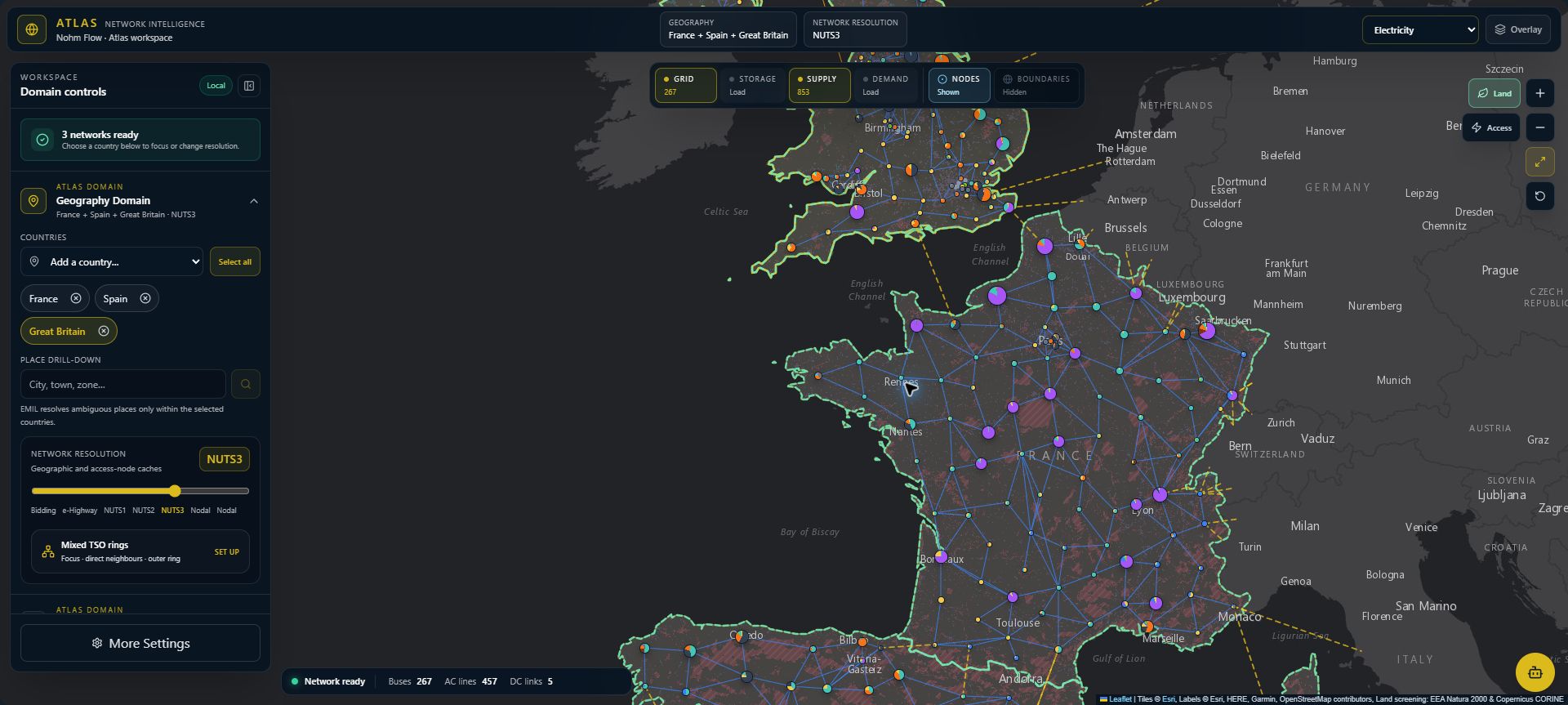
Choose countries, carrier and network resolution, from bidding zones to NUTS3 or nodal detail. Overlay demand, supply, storage, land constraints and grid access, then inspect the node behind the map.
 Contact
 Energy intelligence / A TerraJoule platform
Nohm brings maps, network data, model results and specialist assistants into one environment. Teams can inspect the existing system, compare scenarios and test a proposed change without losing the sources and assumptions behind the result.
Visit Nohmenergy.com01 / Nohm Atlas
Atlas shows energy infrastructure and model data on the map. Select countries and carriers, move from bidding zones to individual nodes, and add demand, supply, storage, land or grid-access layers.
02 / The working surface
Start with the available data. If the question needs a model run, Nohm carries the same assumptions into the simulation and brings the result back for review.
Choose countries, carrier and network resolution, from bidding zones to NUTS3 or nodal detail. Overlay demand, supply, storage, land constraints and grid access, then inspect the node behind the map.
Review nodal and system balances, generation, storage, trade, curtailment, flows and scenario comparisons.
Trace a result through demand, weather, capacity, network constraints, dispatch and market assumptions to understand what caused it.
Propose a model change and send it to the right modelling engine. Nohm explains the assumptions and returns the result for review.
Emil is the core modelling intelligence. Lola shapes reports, Theo works through economics, and Nova keeps meetings, decisions and project context connected.
03 / Nohm ONE
Nohm ONE links an investment or planning question to the operational detail needed to answer it. The same assumptions move through investment, reliability, resources, operations and testing before a decision is made.
Explore Nohm ONEScreen candidate assets against need, cost and system value.
Test availability, outages and maintenance against adequacy and EENS.
Carry storage, fuels, water and other cross-carrier limits through the plan.
Run dispatch and market windows with explicit state transfer in Nohm Flow, PyPSA or PLEXOS.
Balance, compare, stress and send changed assumptions back upstream.
Adapters for Nohm Flow, PyPSA and PLEXOS keep the same mappings and assumptions between tools. If a sensitivity changes an input, the analysis returns to the affected stage and runs again.
04 / How answers are presented
Each answer shows the source, method and assumptions used to produce it. Changes to a model stop for review before they are run.